**Warning: This song contains strong language and references to sexual assault.**
Before jumping into Dana Dan, some thoughts.
In the late 70s, hip hop was born on the dancefloors of the Bronx, where DJ Kool Herc was throwing his first “merry-go-round” parties. There was a purity to the music of hip hop; MCs would “toast” (a Jamaican term for what we’d now call “rap”) with lyrics relevant to the audience in front of them and DJs were creating musical experiences for the pure joy of dance and escapism.
Over time, however, as the artform spread and gained commercial success, the music industry began eroding the purity of the music, absorbing it into the “pop” framework where all genres go to lose their souls. Rappers and beatmakers found themselves in the plight of all artists throughout modern history: do I make my music for the art of it, or do I make music that puts food on the table?
The same loss of artistic integrity can be said of every genre of music. The rock and country music of the radio today don’t carry the same emotional and story-telling weight compared to their gospel, bluegrass and blues roots. Even Western classical music has been absorbed in some ways by the corporate machine. For instance, composers often make a conscious decision between writing music for a beginner-level orchestra that will be purchased with government money or creating a work of art that just happens to be “easy” enough to be performed by beginners.
Currently, the only escape from this system is through independent media. Instagram, YouTube, Spotify, and other platforms like Audius, Patreon, etc. allow for small artists, writers, producers, and audio professionals to build their own brands and businesses brick by brick with direct help from their dedicated fan bases.
In the heavy metal world, the Indian Band Bloodywood is a perfect example of this.
Check out Bloodywood’s rise to stardom in this documentary.
I discovered Bloodywood about a year or two ago. I’ve been interested in music from other parts of the world for a long time, especially metal. When I was a kid, I was introduced to Rammstein (I had no idea what the German lyrics were until later… oof). My favorite symphonic metal band Nightwish is from Finland. My favorite EDM musical act that dabbles in metal, Infected Mushroom, is originally from Israel. One of my former percussion students and I often exchange clips like this Djembe drum circle or this tabla and flute performance.
To the point, I had discovered The HU several years ago. My favorite thing about the HU is their use of traditional Mongolian instruments and performance techniques like throat singing. I wanted to see if other cultures had metal acts that also incorporated traditional music into their songs.
So, one day, I typed “traditional Indian heavy metal” into Google.
And up popped Bloodywood’s Dana Dan.
If you already watched the video embedded at the top of the post, you know that this song is an anthem to not only the destruction of sexual predators, but also a call to strong community and for men to own their roles as protectors. It’s powerful and forward looking.
And… the music is amazing! The production value is high: the mix always keeps the dhol (a traditional Indian drum) in your ear, the guitar and bass sound incredible, the synth sound during the bridge is haunting and clean, and the rapping and singing are superb.
This song has been out since 2022 and was featured in the end of the final fight scene of Monkey Man (2024); the music video been seen by millions of people. There are many reaction videos and breakdowns of this song online, both musically and thematically, so I won’t rehash these analyses.
Instead, I propose this song is a perfect example of what true art can be: catharsis.
Specifically in this case, I invite you to check out the comments section below the YouTube video. Hundreds of survivors of sexual assault pour their hearts out, thanking Bloodywood for their work and sharing their stories.
The bridge of the song gets me every time. Despite the anger and frustration and fire throughout the song, Raoul Kerr (the rapper) says:
Yeah, yeah
Now, if you strayed, time to turn back
And run with the pack
It’s time to fight, yeah, yeah
We got the ammo to stack
F— every man for himself
It’s every man for every man and everybody else
Everybody else[Rise!] I raise a fist for the nameless faces he disgraces
Raise a fist for the nameless faces he disgraces
And yeah, one day I may change his kind with my mind
One day I may change his kind with my mind[Rise!] I raise a fist for the nameless faces he disgraces
Raise a fist for the nameless faces he disgraces
And yeah, one day I may change his kind with my mind
One day I may change his kind
But until then…
For me, the inclusion of the line “…and yeah, one day I may change his kind with my mind” is what elevates this song from what could’ve been a bloodthirsty glorification of revenge into a genuine call for justice. The lyrics throughout the verses tend toward violence in response to violence (an understandable metal trope which matches perfectly with the raw sound of distorted electric guitars), and the chorus is clearly violent (“de dana dan” in Hindi can be translated “beatdown” or “hit left and right” depending on who you ask). All of this perfectly captures the emotional response of the artists to the subject matter, of course.
But threaded throughout the song, and especially within the bridge with Jayant Bhadula growling “RISE!” over top and a masterful upward key shift, Dana Dan offers hope for a solution other than a descent into a violent cycle.
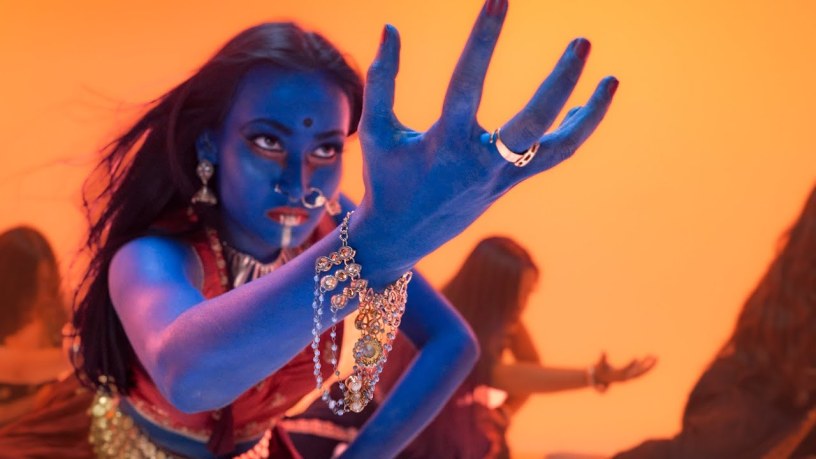
The inclusion of the goddess Kali (the dancer in blue) in the video adds another layer of depth here as well. According to the Devi Mahatmaya, chapter 8, Kali helps defeat a powerful demon named Raktabija by preventing him from spawning more copies of himself… a perfect analogy for what Bloodywood might envision for rapists and “their kind.”
The reason I started this post off talking about the tension between commercial music and art music is that at its core, art is an expression of the human condition. Art is how we process, how we crystalize, our experiences and emotions into something we can point to, share, and contemplate at a distance. In a way, we can remove ourselves from what’s inside so we can better deal with it. The bands that “make it” outside of the Western music “pop” machine have a much better chance of holding onto their values, their cultures, and their message.
Seeing how this song has affected so many people in such a positive way, along with my own visceral reaction to the lyrics, combined with the authenticity of the artists of Bloodywood, make this song an amazing example of what art can… and should… do.
 YHWH's Janitor