This is #2 in my "Testing the Hypothesis" series where I interact with "Original Monotheism" as defined by Wilhelm Schmidt. You can read the hypothesis here. Click here to see: #1, Part 1, Part 2.
In Chapter 5 (“Myth and Folklore“, p. 63-75) of The Oxford Handbook of the Archaeology of Ritual and Religion, Amy Gazin-Schwartz explores how the study of myth and folklore influences archaeological studies of religion and ritual. Her article includes an Introduction, where she defines terms, followed by presenting historical perspectives on folklore and archaeology, problems that arise while trying to understand traditions, how folklore and archaeology relate to each other, interpretation of said knowledge classes, problems with determining “authenticity”, and finally her conclusions.
This article was interesting to me in regards to original monotheism. One of the things that is striking about ancient monotheism is that if the God of the Bible is the same as the Supreme Being that ancient hunter-gatherers followed, we would not expect much in the way of physical evidence. After all, when Yahweh first interacts with the humans in Genesis 1:28-30, the only instructions he gave were to “be fruitful and multiply,” “fill the earth,” “subdue [the earth],” and to rule every creature on earth. In addition, every animal and plant on earth are “given” to humankind. If this is true, the only archaeological (or, physical) evidence we’d expect might include:
- Evidence of the relatively “quick” and global spread of humankind and an emphasis on mobility over settlement
- Usage of nature for food
- As opposed to, say, widespread cannibalism in hunter-gatherer societies with the oldest cultures.
- Respect for dead human bodies in burial and a lack of widespread warfare
- Due to the imaging status of humankind; in other words, humans were “representatives of God on Earth” and were therefore afforded respect as fellow imagers by other humans – Genesis 1:26
- Wide variety of interpretation among hunter-gather societies of how surrounding environs and wildlife were to be “dominated” based on environment, climate, and circumstances
- ie, each tribe would “dominate” their local environs uniquely compared to other tribes in culturally innovative ways
There is little in Genesis 1:26-30 that would result in widespread archaeological evidence of how these monotheistic cultures worshiped. This is because there’s no prescription of how, when, or where to worship the Supreme Being; wide latitude was given to humans regarding how they should “live out” the mandate they’re given based on their God-imaging ontology.
Using Folklore and Archaeology Together
Definitions (p. 63):
Myth – the genre of folklore particularly concerned with sacred stories about cultural origins.
Folklore – traditional oral traditions that include stories, songs, oral histories and prayers, place names, work practices, expressive arts, material culture, and traditions of ritual and belief.
This doesn’t mean, however, that the existence of an ancient monotheism is unconfirmable. When using archaeology in conjunction with studying folklore and myth, we can investigate ancient religion through informed archaeology. An important point that Dr. Gazin-Schwartz brings up is illustrated with the following example provided by Phillip Segadika (Gazin-Schartz, p. 69):
“One location, Dimomo cave [eastern Batswana], is associated with tales of danger, such as people experiencing unusual tiredness when they are near the cave, or people being trapped under rocks near the cave (Segadika 2008: 149-51). These tales explain that the site is powerfully associatd with the spirit world, but is not likely to be marked archaeologically because the spirits do not want people to come near the cave.” (“The domestication of landscape through naming and symbolic protection among the Batswapong peoples of eastern Botswana…”, Landscapes of Clearance, 2008, pp. 139-53)
An archaeologist wondering why this perfectly good cave surrounded by many people groups was left completely untouched by humans would probably never discover the real reason unless they investigated the local tribes’ folklore. They did, and they discovered that cave had been viewed by the locals as already occupied… by spirits! The space therefore was unavailable for use.
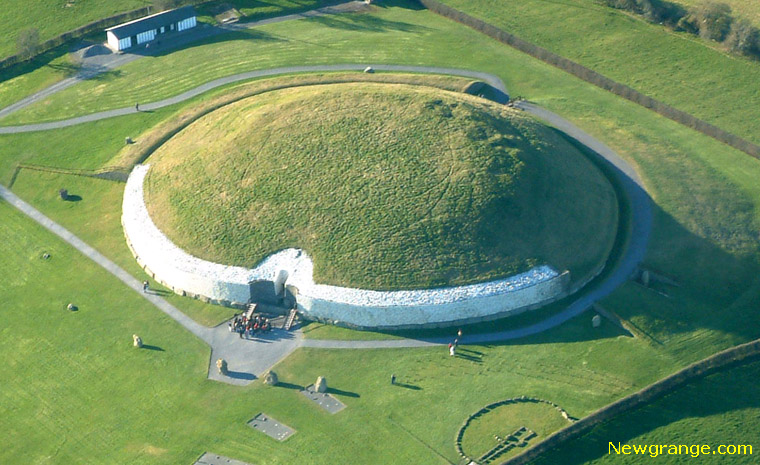
Folklore is useful in discovering long buried relics and providing information about the purposes behind said relic’s designs. Dr. Gazin-Schwartz discusses a study by Tok Thompson (“The Irish Si Tradition“, Journal of Archaeological Method and Theory, 2004) where:
“Folklore about the site of Newgrange, for example, includes information about the effects of the sun entering an opening of the tomb. This phenomenon would not have been physically visible from the time the tomb was sealed in the third millennium BC until archaeologists excavated it in 1967.”
Think about the implications of this statement!
The Folklore of the locals near the Newgrange monoliths preserved important details about the interiors of tombs accurately for roughly 5000 years! Oral tradition is a powerful tool for humans to pass along important information from one generation to another.
Another use of folklore in archaeology includes “public archaeology.” When Leah Carson Powell and Helen Danzeiser Dockall (in their article “Folk narratives and archaeology…, Journal of Field Archaeology, 1995) were excavating a historical African-American cemetery in Galveston, Texas, they had many visitors to the site who shared family histories, helping the scientists find hidden or missing grave stone markers, filling in gaps in their research, and explaining why certain graves had been disturbed in the past. This information gathering (called “public archaeology”) was incorporated into their findings. (p. 71-72)
Although using folklore and myth to elucidate archaeological findings regarding ancient practices, there is, of course, the need for using caution when incorporating folkloric studies into archaeological studies. Dr. Gazin-Schwartz mentions a few reasons (p. 72):
- Folklore and myth attached to an archaeological site may indicate more recent (rather than the most ancient) rituals or beliefs associated with the site.
- New(er) rituals developing around a site might indicate changes in the site’s ongoing cultural prominence, and must therefore be vetted.
She articulates this with the understanding that archaeologists must use the same kind of due diligence when addressing folklore data just like they do with physical remains.
Conclusion
So what does this mean for original monotheism?
It is important that every family, every tribe has its own history. Dr. Gazin-Schwartz’s example of “public archaeology” at the Texas cemetery illustrates how families’ histories interacted with the histories of other families. Wilhelm Schmidt spent a lot of time writing about how his Culture Circle method (where he traced the cultural development and age of culture types through time) showed how people groups’ beliefs don’t “evolve over time” like many anthropologists believe(d), but rather moved until they couldn’t move anymore to preserve their most important core cultural forms. The same can be true of these families’ histories. They overlayed one another to create a tapestry of unique folkloric threads within one cemetery.
As we delve into the question of the oldest religion, many modern scholars will point to shamanism. [ 1, 2 ] Shamanism produces an archaeological imprint along with a vivid ethnographic memory. And I would agree that shamanism does appear to be the oldest form of religion that we can see in the archaeological record.
However, when also taking into consideration Schmidt’s ethnographic discovery of monotheism in the most ancient of hunter-gatherer cultures around the world, we must be purposeful to incorporate all cultural forms when addressing the question, not just physical remains. There is often more to the story than what the archaeological record alone tells us.
 YHWH's Janitor