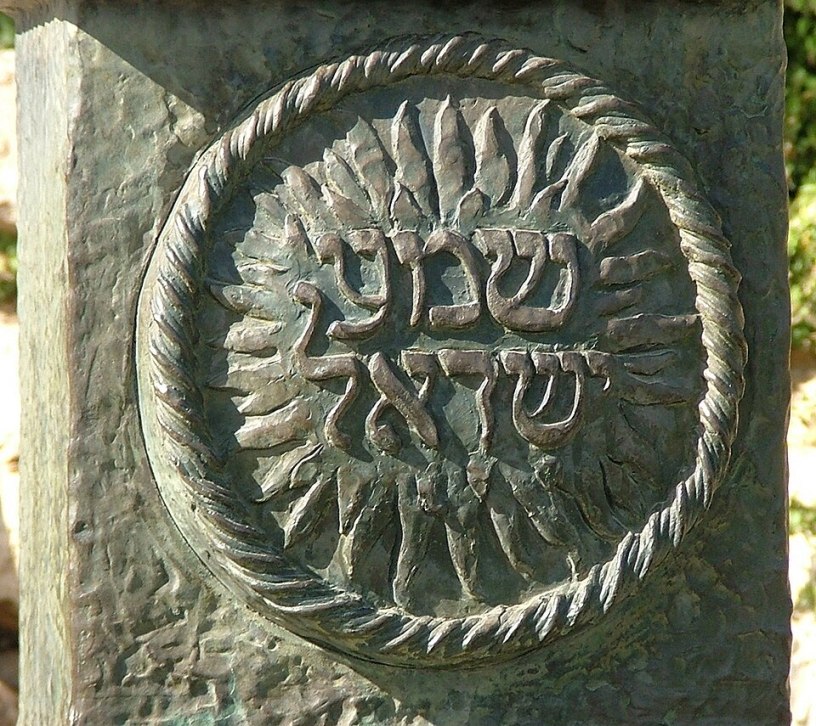
4 “Hear, O Israel: The Lord our God is one Lord;[a] (RSV)
Deuteronomy 6:4
This is the Shema, one of the most famous Biblical passages within the Jewish (and Christian) scriptures. Oftentimes, Jews will use the Shema as a proof text against the idea of the Trinity. After all, if the LORD is “one,” how can He be made up of three (or two… or ten…) persons?
I recently heard a claim that the Shema actually supports (or at least, does not deny) the idea of a multi-personal Godhead. Since this sounds a bit too good to be true for trinitarian Christians, I decided to look at it on my own.
Quick breakdown of the Shema
First, what is the Hebrew for this famous Biblical passage?
שְׁמַע יִשְׂרָאֵל יְהוָה אֱלֹהֵינוּ יְהוָה אֶחָד
Reading right to left (which is what Hebrew does):
shema (שְׁמַע) y’israel (יִשְׂרָאֵל) Yahweh (יְהוָה) elohenu (אֱלֹהֵינוּ = elohim w/ first person plural pronoun suffix) Yahweh (יְהוָה) eḥāḏ (אֶחָד)
If we disregard English grammar for a moment, we get something like:
“Hear Israel Yahweh our God Yahweh one”
Clearly, a dry word-for-word translation just doesn’t make much sense in English. This is one of those times where I think we should take a moment to appreciate the work that translators do for us. Often times they must make difficult judgement calls when translating Hebrew into English because there’s always a chance you could lose nuance.
In this phrase, there is no verb supplied, only implied. Legitimate translations of the Hebrew include:
- The Lord our God is one Lord.
- The Lord is our God, the Lord is one.
- The Lord our God, the Lord is one.
Notice the verb “is” is always provided in English even though there isn’t a Hebraic equivalent. To make the English work, we have to supply the verb.
But what if we sit in the ambiguity for a second?
I actually like thinking about it like it is: “Hear Israel: Yahweh, our Elohim, Yahweh… one.” It’s not poetry, but the simplicity of the idea presented is interesting to ponder.
The Hebrew word eḥāḏ (אֶחָד)
The word eḥāḏ (translated here as “one”) implies a “uniqueness” or a “stand-alone-ness.” Its usage in this passage does not necessarily contradict a multiplicity inside the “oneness” or “uniqueness” of Yahweh; for instance, Adam and Eve are described as becoming “one flesh” (same word) in Genesis 2:24:
Therefore a man shall leave his father and his mother and hold fast to his wife, and they shall become one flesh. (ESV)
The word “one” is eḥāḏ, describing the flesh of the two humans coming together. Clearly, there are two humans that are separate and distinct, but yet the use of the term “one flesh” indicates that this union is something unique, something separate, from all other unions.
The point?
Clearly, this isn’t some knock-down argument for the existence of the Trinity in the Shema. But, in my opinion, you certainly can’t use the Shema as a claim against the multiple personhood that makes up the Godhead of Yahweh.
Lastly… God is listed three times (two personal names, Yahweh, and the identifier elohim) in a row and then called eḥāḏ…?
Fascinating.
For more information, check out The Bible Project’s article and video series on the Shema.
 YHWH's Janitor
And yet, the phrase in the anonymous gospel of John / the Johannine Comma is a later Christian interpolation: a rank fraud.
It always makes me shake my head at the lengths of disingenuity apologists/ Christians will go to in order to justify their man made faith.
LikeLike
Hey Ark! First of all, it’s in 1 John (an epistle), not the gospel of John.
Second, because of the copious amount of manuscript evidence we have, the extra insertion is no longer used in modern Bible translations because of the lack of evidence to keep it in. The issue was known and debated as early as the 4th century; the Comma only showed up in Latin texts, not any of the older Greek, Coptic, Syriac, Georgian or Arabic manuscripts. We have so much information about the history of the Bible that we can isolate where and when errors like this were made.
Should the 4th century scribe have added it? No, but I understand why he’d do it. He was likely concerned with the anti-Trinitarian movements within the church at the time as Christianity spread through Europe. It just muddied the waters for future generations.
LikeLike
Correct: 1John not gJohn.
My apologies.
However, the point stands.
The Trinity is a man made doctrine and the John epistles are considered “anonymous forgeries”. (As is so much of the NT)
Your use of the term “error” suggests an ‘Ooops’ moment and somewhat hand waves/ excuses the overriding insidious side of Church history and scholars’ blatent intent to deceive.
It is disgusting that such egregious nonsense is still touted as God Breathed(sic)/inspired.
LikeLiked by 1 person
Thank you, no worries. 🙂 The Trinity is deeply rooted in the Jewish Tanakh. The scribe who inserted the Comma issue you cite was misguided; luckily, we have excellent manuscript evidence to catch these issues and correct the ship.
LikeLike
False. There is not even an allusion to the Trinity in the Tanakh.
Consider the passage in Deuteronomy.
All you are doing is spewing indoctrinated apologetics.
The Trinity is a man made Christian doctrine. Period.
LikeLiked by 1 person
I should add, that although your post tries to justify the invention of the Trinity by some highly convoluted nonsense if you could get a Jew to support your far fetched claim that would be worth reading😊
LikeLiked by 1 person
lol it would, for sure! 😀 Although, I’m sure you know that there are many Jews who have accepted Jesus as their Messiah… I just don’t know any Messianic Jews personally since I’m in a very rural area. As for convoluted presentations, I think the multiplicity of Yahweh is presented throughout the Tanakh (ex., Genesis 19:24, Psalm 110, Isaiah 53, Daniel 7). According to the Jewish scholar Alan Segal (Two Powers in Heaven) this weird “two Yahwehs” thing was discussed by Second Temple Period rabbis openly until the church took root… then the rabbinic writings started shutting down discussion of it in the 200s AD.
LikeLike
Judaism rejects the claim the character Jesus of Nazareth is the Messiah.
Messianic Jews are not recognized by the Jewish community.
The point stands.
LikeLiked by 1 person
You asked for a Jew who agrees with me; I point out some Jews who agree with me; you say they’re not Jews if they agree with me.
If I am a noun and I add an adjective to myself, I’m still the noun. Even if the other nouns don’t recognize me now because of my adjective.
LikeLike
They are not regarded as as Jews by mainstream Jews. If that ‘s good enough for them it’s good enough for me.
LikeLike
Hey YJ!
Thanks for the blog, i’m enjoying reading it!
Was wondering whether ‘alone’ or ‘only’ could fit the lexical range of ‘ehad’
something like
‘Hear O Israel, the LORD is our God, the LORD alone’ …
The meaning being one of exclusive covenant loyalty rather than ontological description. Is that possible or overreach?
LikeLiked by 1 person
Thanks, Pete! I don’t know for sure… I’m not a Hebrew grammar expert, so I could always be wrong on these things. I suppose you could supply the verb there in an English translation; that would make sense, because in the next verse, the author reiterates the idea you present. “You shall love the LORD your God with all your heart and with all your soul and with all your might.” (ESV) I’m also open to the possibility that the original Hebrew-speaking audience was encouraged to take in all the possible meanings simultaneously and mull over them. It’s such a rich language!
LikeLiked by 1 person
Cool, thanks. Also, i read somewhere on your blog a recommendation to read Spirit of The Rainforest – i am and its fascinating! Thanks so much!
LikeLiked by 1 person
Excellent! God bless you, sir, and thanks for letting me know. That’s very encouraging. 🙂
LikeLike